Thrill withdrawals: network, TXID and KYC evidence
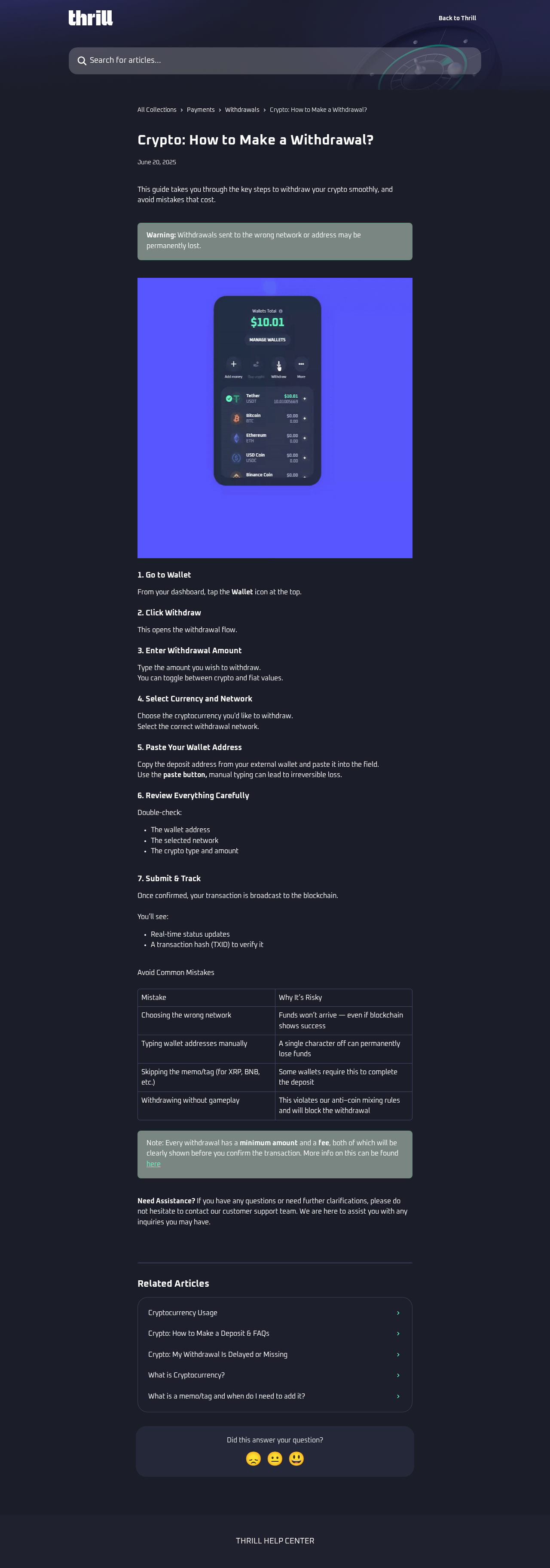
A Thrill crypto withdrawal should be assessed as a sequence of separate events, not as one promise of payment. First, an account holder submits a withdrawal request. Second, the transaction may receive a blockchain transaction ID, or TXID, and a status. Third, the receiving wallet or platform must credit the funds. These events can have different causes, records and outcomes.
The available evidence consists of Thrill help articles published on 20 June 2025, 4 December 2025 and 29 May 2025, retrieved on 6 October 2026, together with a dated iGaming Ontario directory observation. The operator material describes procedures and contact channels; it does not document a tested payout. It also does not establish that Thrill is accepted in every Canadian province or territory.
What a withdrawal record can and cannot show
A request visible in an account shows that a withdrawal instruction was submitted. It does not by itself show that funds left the operator, entered a blockchain transaction or reached the destination. A TXID is a record associated with a blockchain transaction, but it is not proof that the receiving account belongs to a particular person, nor does it guarantee that the destination wallet will credit the transfer.
The receiving platform may use its own confirmations, asset rules, maintenance procedures or destination checks. A confirmed transaction that is not credited should therefore be investigated with both the receiving platform and Thrill, using the account and transaction records available.
| Stage | Useful evidence | What remains unknown |
|---|---|---|
| Request submitted | Account withdrawal record, selected asset, network, amount and time | Whether the request was approved, rejected or broadcast |
| Blockchain transaction | TXID and matching asset and network | Whether the destination platform will credit it |
| Receiving credit | Receiving-wallet or platform record | Whether any account-side restriction or mismatch remains |
Check the network before confirming
Thrill’s published withdrawal guide says users should select the currency and network, enter the external wallet address, review the address, network and amount, then submit and obtain a TXID. Treat each field as a separate check. A correct address on the wrong network can still result in a loss or an uncredited transfer. The destination must support the selected asset and network.
Some assets also require a memo or tag. The operator guide warns that a missing memo or tag can cause loss. Do not rely on a familiar asset name alone: compare the network shown in the withdrawal screen with the network supported by the receiving wallet or platform. If the destination does not clearly support the selected combination, pause rather than guessing.
| Before submission | Record or verify |
|---|---|
| Asset and network | Confirm that both are supported by the receiving destination |
| Address | Compare the full destination address; do not rely only on a shortened display |
| Memo or tag | Check whether the destination requires one and copy it accurately |
| Amount and fees | Review the amount and the fee shown before final confirmation |
| Account record | Keep the request details and later TXID or status |
Fees and minimums are not fixed promises
A Thrill fee guide dated 4 December 2025 describes currency- and network-specific minimums and fees. It also states that the operator places no maximum withdrawal restriction on the available balance. That statement should not be converted into a promise of an immediate or unconditional payout. Verification, contractual eligibility, account status and the current confirmation screen remain separate matters.
Older fee tables should not be treated as current fixed amounts. The practical check is the amount and fee displayed for the selected asset and network at the time of confirmation. Save that information with the withdrawal record if the account interface provides it. A fee shown before confirmation can help explain the amount requested and the amount expected, but it does not prove that the receiving destination will credit the transfer.
How KYC or AML checks fit into the process
Thrill’s registration article dated 29 May 2025 says that documents are not required to finish initial registration. It also says that accounts flagged during KYC or AML checks may be notified by email or dashboard and asked for additional documents. Initial registration is therefore not evidence of a permanent exemption from verification.
A document request can affect the account-side handling of a withdrawal, but the available evidence does not state how a particular account will be assessed or how long a review will take. Use the notice shown in the account or sent by the operator as the starting record. Keep copies of the request, the submission date and any case reference, while avoiding unnecessary disclosure of sensitive documents through an unverified channel.
How to interpret pending, confirmed and failed statuses
Thrill’s troubleshooting guide dated 20 June 2025 directs users to locate the TXID, inspect the correct network and distinguish pending, confirmed, and dropped-or-failed statuses. It also advises checking the receiving address, network, memo and destination support. These checks help identify whether the issue is still at the account or transaction stage, or whether it has moved to the receiving platform.
Published network time estimates are not a payout service-level agreement. A pending status is not proof of fraud, and a delay alone does not establish that funds have been taken. A dropped or failed status requires a different follow-up from a confirmed transaction that has not been credited. Preserve the exact status and its time rather than describing every outcome as a missing withdrawal.
A practical evidence checklist
- Record the withdrawal request date, asset, amount, selected network and any fee shown before confirmation.
- Check the full receiving address and whether a memo or tag is required.
- Confirm that the receiving wallet or platform supports the same asset and network.
- Save the account status and obtain the TXID if one is provided.
- Match the TXID, asset and network to the transaction information available to you.
- If the transaction is confirmed but uncredited, contact the receiving platform and provide its requested transaction details.
- If the issue remains unresolved, contact Thrill through its published support channels and retain the case record.
Escalating a delayed or missing withdrawal
Thrill’s published support article, dated 29 May 2025, lists on-site live chat and support@thrill.com for deposits, withdrawals, login, bonuses and verification. It advertises 24/7 availability, but that remains a published contact claim rather than a tested response-time result. Availability should not be taken to mean an immediate resolution.
For an account-side question, provide the withdrawal reference, status, asset, network and relevant dates, while limiting personal information to what is reasonably required. For a confirmed-but-uncredited transaction, the operator’s troubleshooting guidance points first toward the receiving platform, because crediting occurs at the destination. Retain the exact status, network details and any relevant account record when requesting clarification.
You can also compare the broader Ontario context through our Ontario regulated casino check. The iGaming Ontario directory retrieved on 6 October 2026 described its listing as accurate on 1 September 2026 and did not include Thrill or thrill.com. This is a directory observation, not a fraud finding or a Canada-wide legal opinion. Ontario play, including the directory’s 19+ and physical-presence context, should not be treated as a statement about all of Canada. For a wider evidence framework, see casino payment risks and Thrill domain and operator identity evidence.
What this evidence does not establish
The supplied records do not include a personal withdrawal test, a verified payout receipt, a guaranteed processing time, a blockchain explorer record, a finding that every Canadian user can register or withdraw, or a licence verification for a particular Canadian jurisdiction. They also do not show that every delay is fraudulent. The most defensible conclusion is narrower: a user can document the request, transaction status and receiving credit as separate stages, then escalate using the records for the stage where the problem appears.
Frequently asked questions
Does a Thrill withdrawal request prove that payment was sent?
No. A request shows that an instruction was submitted inside the account. It does not by itself prove that Thrill approved it, broadcast a blockchain transaction or that the receiving wallet credited the funds.
Does a TXID guarantee that my receiving wallet will be credited?
No. A TXID can help identify a blockchain transaction, but it does not guarantee destination credit or prove ownership of the receiving account. Check the asset, network, address, memo or tag and the destination platform’s records.
Can Thrill request KYC documents after registration?
Yes. Thrill’s 29 May 2025 registration article says documents are not required to finish initial registration, but accounts flagged in KYC or AML checks may be notified by email or dashboard and asked for additional documents.
Are Thrill’s network time estimates guaranteed payout times?
No. The troubleshooting guide’s network estimates are not an operator payout service-level agreement. Keep the exact status and TXID, and investigate whether the transaction is pending, confirmed, dropped or failed.
What should I do if a confirmed withdrawal is not credited?
Check the receiving address, asset, network, memo or tag and destination support. Thrill’s guide recommends contacting the receiving platform for a confirmed but uncredited transfer, then contacting Thrill support if the issue remains unresolved.
Ready to play?
Checked the evidence? Open an account with a partner option in a couple of minutes.
19+ only. Sponsored partner link. Play responsibly.